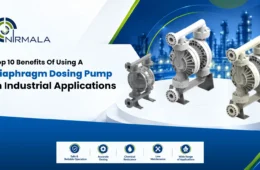
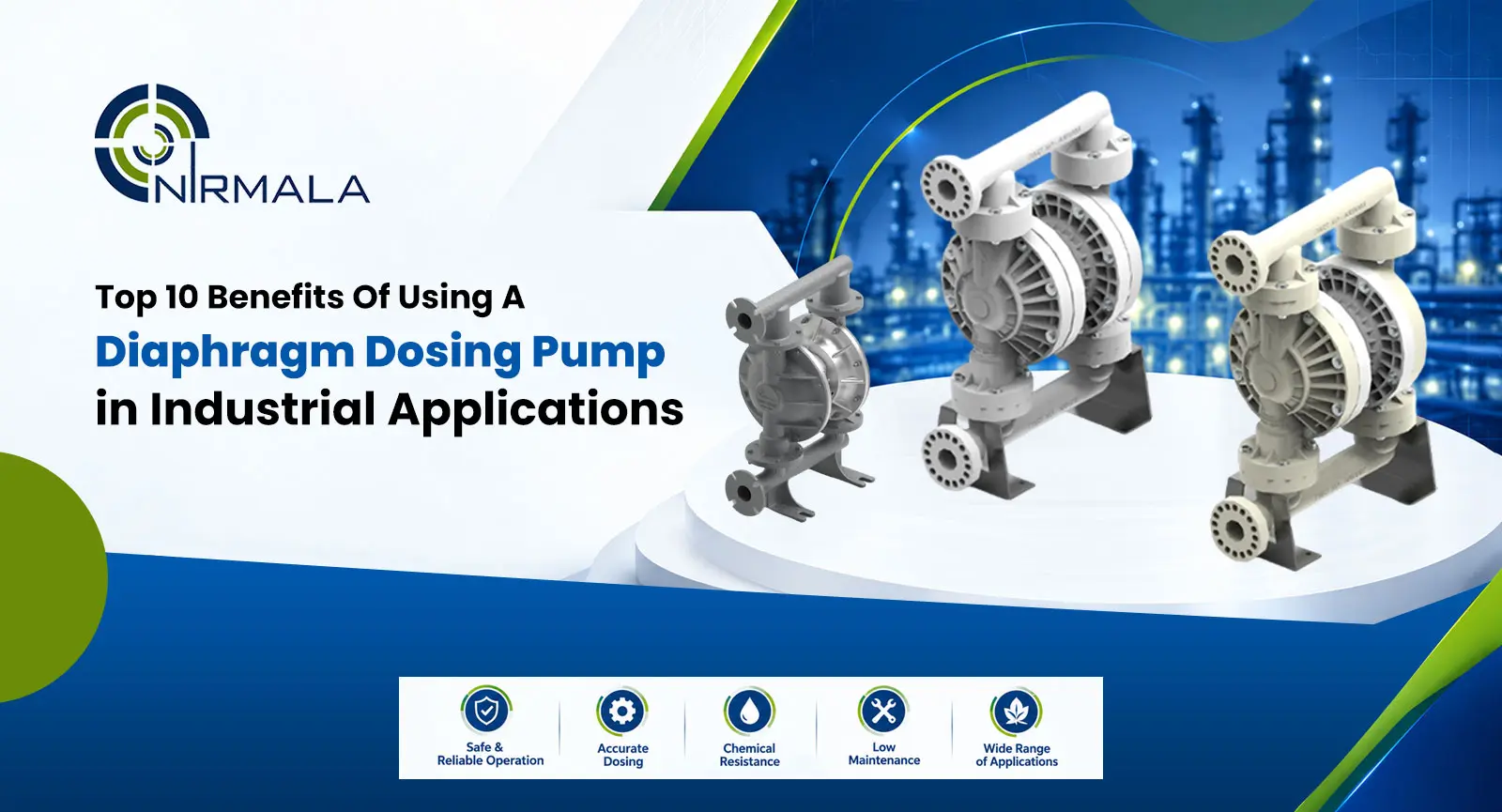
Quick Summary: A diaphragm dosing pump delivers a measured chemical dose stroke after stroke, without that chemical ever touching the drive. This article covers how it works, ten benefits that show up on a plant floor, and the different industries where this pump is used.
Table of Contents
Introduction
Chemical dosing is one of those plant activities that is not noticed until it goes wrong. An antiscalant fed slightly rich for six months shows up as an unexplained consumable bill. A coagulant fed slightly lean shows up as an effluent sample that fails a pollution control board limit. Neither problem shows up on the day it starts. The equipment placed between the chemical tank and the process line is usually a diaphragm dosing pump, a positive displacement pump that pushes a flexible diaphragm back and forth to deliver an exact volume per stroke. It handles acids, alkalis, hypochlorite, and polymers without exposing any of it to a shaft seal. This article covers the working of this pump, ten benefits that translate into measurable plant outcomes, and the industries that rely on them most.How a Diaphragm Dosing Pump Works
The mechanism is simple enough to picture. A motor or solenoid drives the diaphragm backwards, which expands the pump head and creates suction. The suction check valve opens, chemical enters the chamber, and the discharge valve stays shut. On the return stroke, the diaphragm moves forward, pressure rises, the suction valve closes, and the discharge valve opens to push the measured volume into the line. Output depends on two adjustable variables: how far the diaphragm travels (stroke length) and how often it travels (stroke frequency). Change either, and you change the dose. Nothing about the calculation depends on the pressure downstream, which is precisely why these pumps behave predictably where centrifugal pumps do not.The Ten Benefits of Using a Diaphragm Dosing Pump in Your Industry
Each of the following addresses a problem that plant engineers deal with directly. These are some of the major benefits of this pump:1. Dosing Accuracy You Can Actually Hold
Standard models repeat their set point within ±1% to ±2%, and high-precision units hold ±0.5%. Dosing errors compound rather than cancel out. A 10% overdose sustained across a year is roughly an extra month of chemical purchased for nothing, which is why repeatability pays back faster than most engineers expect.2. Sealed Handling of Hazardous Chemicals
The diaphragm dosing pump isolates the liquid from the drive completely, so there is no packing or mechanical seal to weep. Sulphuric acid, caustic soda, and sodium hypochlorite stay contained inside the pump head. For plants working under safety audits, this removes an entire category of leak risk along with the cleanup and corrosion damage that follows it.3. Wetted Parts Matched to Your Chemistry
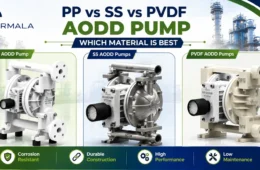
Pump heads come in polypropylene, PVDF, stainless steel, and PTFE, with PTFE-faced diaphragms acting as a broad chemical barrier. PP suits most acids and alkalis, PVDF handles aggressive oxidisers and higher temperatures, and stainless steel suits solvents. Matching material to media is the difference between a diaphragm lasting years and one failing within weeks.4. Steady Output When System Pressure Shifts
Because output depends on stroke and speed rather than discharge head, the dose stays constant as back pressure changes within the diaphragm dosing pump’s rating. A partially fouled filter or a throttled valve downstream does not alter what the pump delivers. A centrifugal pump in the same position would quietly reduce flow as head rose.5. Lower Chemical Consumption Over the Year
Precision converts directly into procurement savings. A water treatment plant dosing hypochlorite continuously will consume noticeably less chemical with a calibrated diaphragm pump than with a manually throttled arrangement, simply because the pump is not compensating for uncertainty by feeding a safety margin on every stroke.6. Self-Priming and Tolerant of Dry Running
These pumps generate enough suction to prime themselves, which is important when a day tank runs low at shift change or when a suction line holds vapour. Recovery is automatic once liquid returns. Pumps that seize or burn out on a dry spell create unplanned downtime that always seems to happen at the worst hour.7. Wide Turndown From a Single Pump
Adjusting stroke length and frequency together gives a broad operating range from one unit, often 10:1 or more. Seasonal load variation, batch and continuous production, and plant expansion can all be absorbed without buying another diaphragm dosing pump. Flow ranges available across models span from 0.1 litres per hour to over 1,000 litres per hour.8. Simple Integration With Plant Controls
Most models accept a 4 to 20 m A signal or a pulse input from a flow meter, which enables flow-proportional dosing. As process flow rises, the dose rises with it automatically. This closes the gap between a nominally correct dose and a correct dose at every moment of the shift.9. Multiple Dosing Points From One Drive
A single motor can drive several pump heads, each delivering an equal or a separately set output. Plants feeding three chemicals into one treatment train save on capital cost, panel space, and wiring, and the dosing stays synchronised because all heads share the same drive.10. Predictable, Low-Cost Maintenance
No internal parts rub against each other, and the pump head needs no lubrication. Maintenance reduces to two consumables: the diaphragm and the valve balls or seats. Both have predictable service lives, which lets you stock spares sensibly instead of reacting to failures. Taken together, these advantages explain why diaphragm dosing pumps dominate chemical injection duties across process industries.Industries Where These Pumps Are Used
Certain sectors depend on this pump type almost by default:- Water and wastewater treatment for chlorine, antiscalant, polyelectrolyte, and pH correction chemicals.
- Chemical processing for acid and alkali metering into reaction vessels.
- Pharmaceuticals where batch consistency is governed by documented dosing accuracy.
- Food and beverage for sanitiser and process aid injection under hygiene constraints.
- Textiles and dyeing where colour consistency depends on reproducible chemical addition.
- Boiler and cooling water systems for oxygen scavengers and corrosion inhibitors.
Conclusion
A dosing pump is judged over years, not during commissioning. The plants that stay out of trouble are the ones that matched wetted materials to their chemistry, sized for their actual operating band, and calibrated at installation. Get those decisions right, and the pump becomes the quietest asset in the plant. Nirmala Pumps builds diaphragm dosing pumps across PP, PVDF, stainless steel, and PTFE configurations, and we would rather help you specify correctly than sell you more capacity than you need.FAQs
What is the difference between a dosing pump and a metering pump?
The terms are used interchangeably across the industry. Both describe positive displacement pumps that deliver a controlled volume per stroke. Some suppliers reserve metering pump for higher-accuracy models, but there is no formal standard separating the two.
How accurate is a diaphragm dosing pump?
Standard industrial models hold ±1% to ±2% of the set point, and high-precision versions reach ±0.5%. Accuracy depends on calibration, correct sizing, and stable suction conditions rather than on the pump alone.
What pressure can a diaphragm dosing pump handle?
Standard models typically operate up to around 20 bar. Hydraulically actuated high-pressure designs go considerably higher, reaching 200 bar and beyond for chemical injection duties in oil, gas, and high-pressure process lines.
Which material should I choose for the pump head?
Match it to your chemical. Polypropylene suits general acids and alkalis, PVDF handles strong oxidisers and elevated temperatures, and stainless steel suits solvents and non-corrosive media. Share your chemical name, concentration, and temperature with the manufacturer before finalising.
How often does the diaphragm need replacement?
Service life varies with chemical aggressiveness, operating pressure, and stroke frequency. Many installations run one to three years on a diaphragm. Scheduling a planned replacement is far cheaper than dealing with an unplanned rupture mid-batch.
Can a diaphragm dosing pump handle viscous liquids?
Up to a point. Moderately viscous polymers dose well with larger suction lines, slower stroke speeds, and a flooded suction arrangement. Highly viscous media usually need a different pump type, so confirm the viscosity limit for the specific model.

Nirmala Pumps & Equipments
Nirmala Pumps & Equipments is an Indian company that manufactures and supplies pump systems, valves, strainers, and pneumatic pumps since 1989. We provide services to different industries, both domestically and internationally, such as citrus, distilling, wastewater treatment, and petroleum.