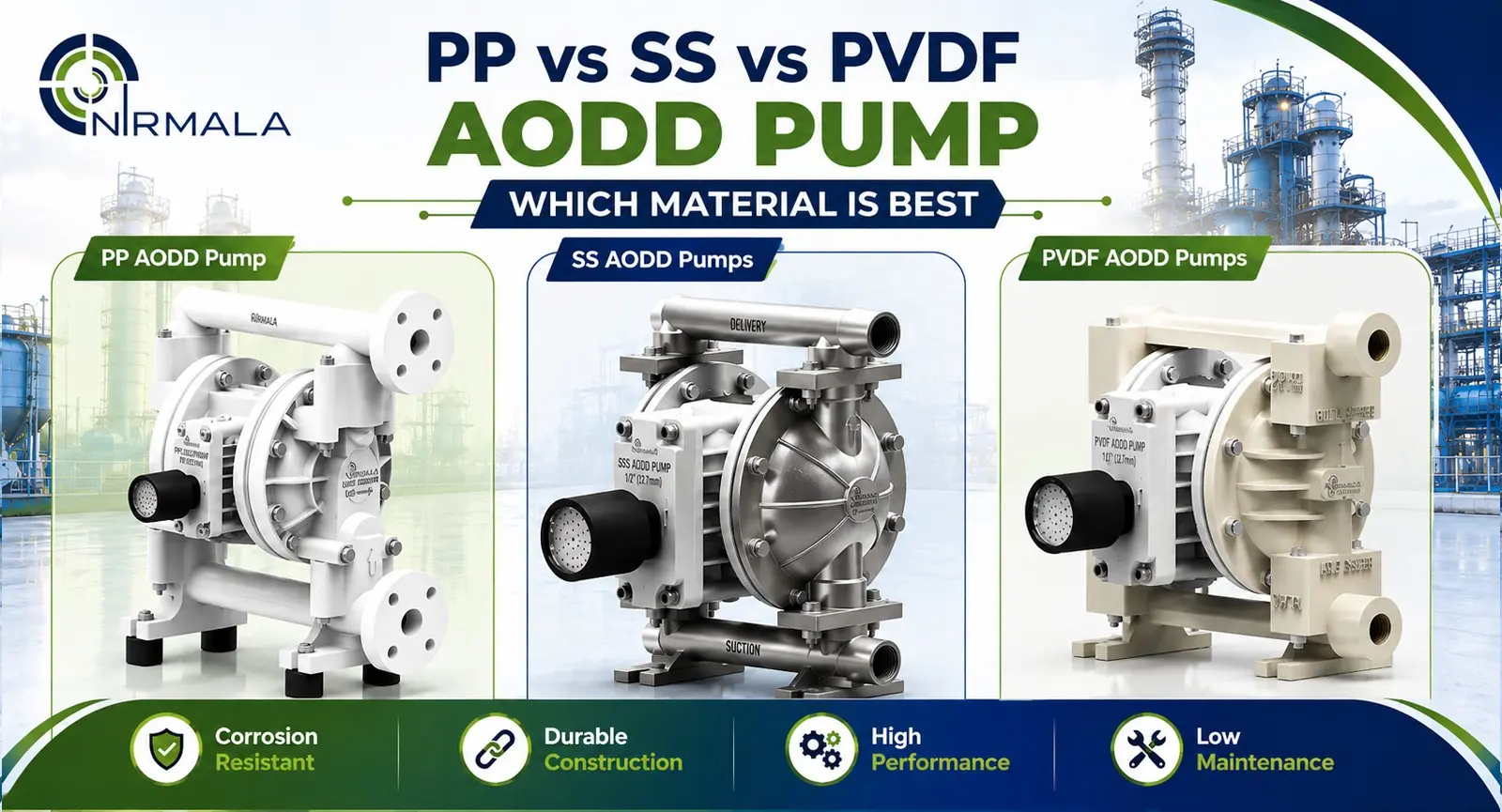
Quick Summary:
There’s no best material for an AODD pump — it depends entirely on what’s being pumped. A PP AODD pump handles dilute acids, alkalis, and general chemical transfer at the lowest cost. A PVDF AODD pump goes further, standing up to concentrated acids, strong oxidizers, and aggressive solvents that would damage PP. An SS AODD pump brings mechanical strength and hygiene, making it the standard choice for food, pharma, and abrasive or high-pressure applications where plastic isn’t practical. Getting the chemistry, temperature, and abrasion level right before choosing is what actually prevents early pump failure.
Table of Contents
Why Material Choice Matters More Than People Expect
An AODD pump — an air-operated double diaphragm pump — moves fluid without electricity, seals, or rotating parts, which is exactly why it’s used so widely across chemical processing, wastewater, food production, and general industrial transfer. But that reliability only holds up if the wetted parts — the body, diaphragms, valve balls, and seats — are actually compatible with whatever’s being pumped.
Get the material wrong, even slightly, and the result usually isn’t a slow decline. It’s swelling, cracking, or corrosion that shows up faster than expected, often followed by an unplanned shutdown at the worst possible time. This is really the whole reason the PP vs PVDF vs SS decision matters as much as it does — it’s not a minor spec, it’s the difference between a pump lasting years or failing within months.
PP AODD Pump — The Everyday Workhorse
Polypropylene is the default choice for a large share of general chemical transfer work, mainly because it strikes a good balance between chemical resistance and cost.
- Handles dilute acids, alkalis, and salt solutions well, typically up to around 30% concentration depending on the specific chemical
- Lightweight construction makes installation and repositioning easier compared to metal alternatives
- Among the most cost-effective options for general industrial and chemical transfer duties
- Not suited to aromatic solvents, strong oxidizers, or concentrated acids — these tend to attack PP faster than expected
A PP AODD pump is usually the right starting point unless the fluid being handled specifically calls for something more resistant. If PP checks out against a chemical compatibility chart, there’s rarely a reason to pay more for PVDF.
PVDF AODD Pump — Built for Aggressive Chemistry
PVDF, often known by the brand name Kynar, sits a tier above PP in both chemical resistance and price — and it exists specifically for the chemistry that PP can’t handle.
- Stands up to concentrated acids, strong oxidizers, and halogenated solvents that would degrade a PP body over time
- Performs reliably even at elevated temperatures, where PP’s resistance starts to drop off
- Denser and harder than PP, giving it better resistance to abrasion from particulates or light slurries
- Very low permeability, which matters in high-purity applications like pharmaceutical or semiconductor processing where contamination has to be avoided
A PVDF AODD pump costs more than PP, but that premium is minor compared to the cost of replacing a pump — or dealing with a leak — because the wrong material was chosen to save money upfront.
SS AODD Pump — Strength, Hygiene, and Heavy Use
Stainless steel, usually SS316, takes a different approach entirely — instead of relying on chemical inertness like plastics do, it offers mechanical strength, durability, and hygienic properties that plastic bodies can’t match.
- Preferred for food, pharmaceutical, and cosmetic applications where hygiene standards and FDA compliance matter
- Handles higher pressure and abrasive or high-solids fluids better than most plastic alternatives
- More resistant to physical impact and mechanical stress in demanding industrial environments
- Not automatically suitable for aggressive chemicals — SS316 is vulnerable to certain acids, particularly hydrochloric acid and chloride-heavy environments, where PVDF is a safer choice
An SS AODD pump is less about outright chemical resistance and more about durability, cleanability, and handling conditions that would be too harsh — mechanically, not chemically — for a plastic pump.
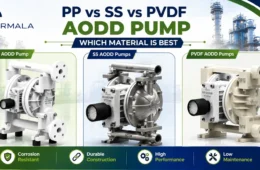
Side-by-Side: PP vs SS vs PVDF
Putting all three together makes the trade-offs easier to see at a glance.
- Chemical resistance — PVDF is the strongest overall, PP is solid for dilute chemicals, SS is chemical-specific and can be vulnerable to chlorides
- Cost — PP is the most affordable, SS sits in the middle, PVDF is typically the most expensive
- Temperature tolerance — PVDF and SS both outperform PP at higher operating temperatures
- Hygiene and food-grade use — SS is the standard choice, particularly where FDA compliance is required
- Abrasion resistance — SS and PVDF both handle abrasive or particulate-laden fluids better than PP
- Weight and handling — PP is the lightest and easiest to install or reposition on-site
None of these materials is universally better — each one wins on different criteria, which is exactly why the decision depends on the specific fluid and application rather than a general preference.
How to Actually Choose Between Them
A few practical questions make this decision far more straightforward than it initially seems.
- What exactly is being pumped, and at what concentration and temperature? Generic labels like “acid” aren’t specific enough — get the exact chemical name
- Is the fluid abrasive, or does it contain particulates or light solids?
- Does the application require food-grade or pharmaceutical compliance?
- What’s the operating temperature range, including any peaks during the process?
- Does the budget allow for PVDF, or does PP already meet the chemical compatibility requirement?
Checking the exact chemical against a manufacturer’s compatibility chart — not just guessing based on general chemical category — is the single most reliable way to avoid picking the wrong material.
Final Word
Choosing between a PP AODD pump, an SS AODD pump, and a PVDF AODD pump really comes down to matching the material to the fluid, not picking whichever sounds the most premium. PP handles the bulk of general chemical transfer work reliably and affordably, PVDF takes over where chemistry gets aggressive, and stainless steel earns its place through strength and hygiene rather than chemical resistance alone. For anyone comparing options or sourcing pumps for a facility, Nirmala Pumps manufactures AODD pumps across PP, PVDF, and stainless steel construction, built to match the specific demands of different industrial and chemical applications.
FAQs
Which is better, PP or PVDF for an AODD pump?
PP works well for dilute acids and alkalis at a lower cost, while PVDF is better suited to concentrated acids, strong oxidizers, and higher-temperature applications.
Can a stainless steel AODD pump handle all chemicals?
No — SS316 performs poorly against certain chemicals, particularly hydrochloric acid and chloride-rich environments, where PVDF is typically the safer choice.
Is PVDF worth the extra cost over PP?
If the fluid falls outside PP’s chemical compatibility range, yes — the cost difference is minor compared to the downtime and damage caused by using an incompatible material.
What AODD pump material is best for food and pharmaceutical use?
Stainless steel is the standard choice for food-grade and pharmaceutical applications due to its hygienic properties and FDA compliance.
Does AODD pump material choice depend only on the pump body?
No — the diaphragms, valve balls, and seats also need to be chemically compatible with the fluid, not just the body material.
Can PP AODD pumps handle high temperatures?
Not as well as PVDF or stainless steel — PP’s chemical resistance and structural stability both decline at higher operating temperatures.
What happens if the wrong AODD pump material is used?
Using an incompatible material typically leads to swelling, cracking, or corrosion of the wetted parts, resulting in leaks or unexpected pump failure.

Nirmala Pumps & Equipments
Nirmala Pumps & Equipments is an Indian company that manufactures and supplies pump systems, valves, strainers, and pneumatic pumps since 1989. We provide services to different industries, both domestically and internationally, such as citrus, distilling, wastewater treatment, and petroleum.