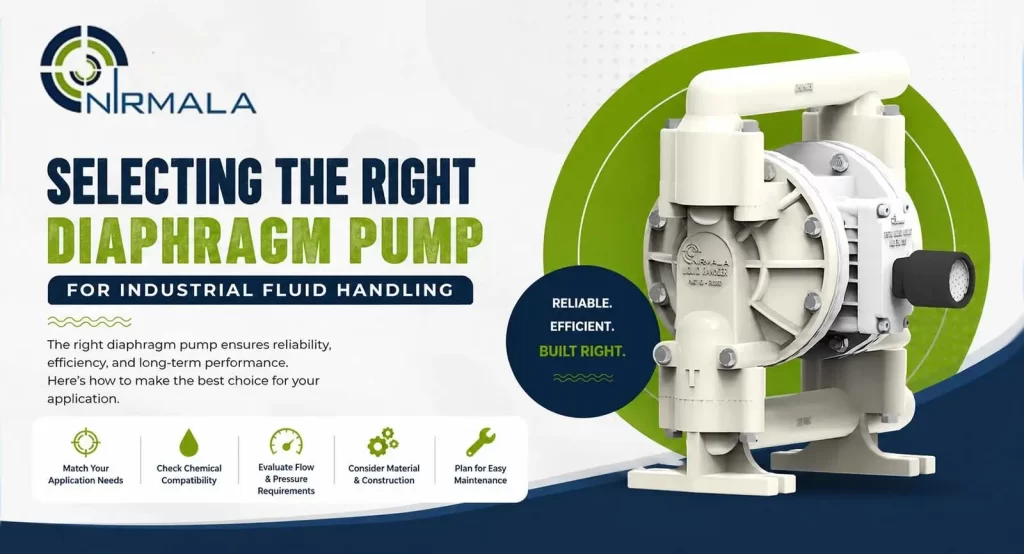
Some fluids are easy to pump. Water, clean oils, and low-viscosity liquids almost any pump handles those without issue. But the moment you are dealing with something corrosive, abrasive, full of suspended solids, or simply too hazardous to risk a leak, the pump selection conversation gets a lot more serious.
That is where most engineers eventually land on the Diaphragm Pump. Not because it is the most powerful option on the market, or the cheapest, but because it handles the difficult stuff reliably. Acids, slurries, thick chemicals, shear-sensitive fluids, and products that cannot be contaminated, the pump manages all of it without the failure modes that eliminate other pump types from consideration.
The catch is that there are several types of pumps, a wide range of material options, and enough configuration variables that a wrong choice still leads to early failures and unexpected downtime. So this article lays it all out, how these pumps work, what types exist, where they are used, and what actually matters when you are making a selection.
How a Diaphragm Pump Works
The operating principle is straightforward. A diaphragm pump is a positive displacement pump; it moves a fixed volume of fluid with each stroke rather than spinning an impeller to generate flow.
Inside the pump, one or two flexible membranes (the diaphragms) move back and forth. When a diaphragm pulls back, it creates a low-pressure zone that draws fluid in through an inlet check valve. When it pushes forward, that same fluid is forced out through a discharge check valve. Back and forth, in and out, that is the entire cycle.
What makes this design genuinely useful is the diaphragm itself. It sits as a physical barrier between the fluid being pumped and the mechanical drive components behind it. The fluid never touches the motor, the air chamber, or any part of the drive mechanism. There are no rotating seals to fail, no lubricants that could contaminate the product, and no impellers to corrode away. That separation is why diaphragm pumps handle aggressive and hazardous fluids so much better than most alternatives.
They also self-prime reliably, run dry without damage, and handle solids in suspension, three capabilities that matter a great deal in real industrial conditions.
Types of Diaphragm Pumps
A complete guide to diaphragm pump selection has to cover the types, because the right one depends entirely on how it is powered and what the process requires.
- Air-Operated Double Diaphragm Pumps (AODD): These are the most common type found in industrial plants. Two diaphragms work in alternating sequence, driven by compressed air. While one pushes fluid out, the other draws fluid in, creating a near-continuous flow.
AODD pumps need no electricity to run, which makes them the natural choice for flammable or explosive environments. Flow rate and discharge pressure are controlled simply by adjusting the air supply; no complex controls are required. They self-prime easily, run dry without harm, and pass solids up to around 12mm in some configurations.
The main limitation is pulsating flow. The alternating stroke action creates flow pulses rather than smooth, steady delivery. For most industrial transfer applications, this is not a problem, but for precise dosing or sensitive processes, a pulsation dampener may be needed. - Electric Diaphragm Pumps: The drive source is an electric motor instead of compressed air. The benefit is a more consistent and smoother flow and improved energy efficiency on long continuous runs.
These pumps are best for chemical dosing and metering applications or any process that requires a continuous flow at a controlled flow rate. Also, they are quieter than AODD pumps. The disadvantage is that they need electrical power, and they are not intrinsically safe for use in hazardous environments such as air-operated pumps.
- Hydraulic Diaphragm Pumps: Pressure is applied to the back of the diaphragm by hydraulic fluid instead of air or a direct mechanical link. This allows very high discharge pressures, sometimes greater than 100 bar, with the fluid completely isolated from the drive system at all times
They are used in high-pressure chemical injection, oil and gas applications, and precision dosing at high pressures that other types of pumps cannot reach.
Understanding the different types of diaphragm pumps helps to select the right solution for efficient, reliable, and application-specific fluid handling.
Where Diaphragm Pumps Are Actually Used
These pumps are not a niche solution for one or two industries. They show up across practically every sector that handles difficult or sensitive fluids:
- Chemical processing– Moving acids, alkalis, solvents, and reactive fluids that would corrode or damage other pump types quickly.
- Food and beverage– Sanitary-grade diaphragm pumps handle sauces, syrups, dairy, and ingredients that cannot tolerate contamination.
- Pharmaceuticals and cosmetics– Sterile transfer of active ingredients and formulations where even minor contamination is unacceptable.
- Oil and gas– Chemical injection, produced water handling, and hydrocarbon transfer in demanding field conditions.
The broad range of applications of diaphragm pumps reveals their versatility, reliability, and efficiency in many industries and operating environments.
Conclusion
Pumps are an important tool in industrial fluid handling by doing what other pumps cannot do reliably: handling the difficult, aggressive, sensitive fluids that keep showing up in real processes. Once you understand your fluid and your process requirements clearly, the right configuration follows naturally from there. The diaphragm pump from Nirmala Pumps that fits your application well will run for years with minimal attention. The wrong one will remind you of the mistake regularly.
FAQ’s
1. Can a diaphragm pump handle solids in the fluid?
Yes. This is one of the practical strengths of pumps compared to centrifugal or gear pumps. Standard designs handle spherical solids up to around 3mm in diameter. Heavy-duty and specialist configurations can manage particles up to 12mm. Solids concentration of up to 30% by volume is achievable with the right material selection and pump configuration.
2. Our load keeps changing throughout the day. Will that damage the transformer?
Not if it’s sized correctly from the start. Variable loads are normal in most facilities, which is exactly why we always recommend adding a 20–25% buffer over your calculated load.
3. From oil-cooled or dry-type, which one should we go for?
For outdoor or heavy industrial use, oil-cooled is the stronger choice. If it’s going inside a building, especially around people, dry-type is safer and far less of a headache maintenance-wise.
4. What's the one maintenance mistake that shortens transformer life the most?
Ignoring the cooling system. Whether it’s the oil level in an oil-cooled unit or blocked vents in a dry-type, heat is what kills transformers slowly, and most people don’t check it until something goes wrong.

Nirmala Pumps & Equipments
Nirmala Pumps & Equipments is an Indian company that manufactures and supplies pump systems, valves, strainers, and pneumatic pumps since 1989. We provide services to different industries, both domestically and internationally, such as citrus, distilling, wastewater treatment, and petroleum.